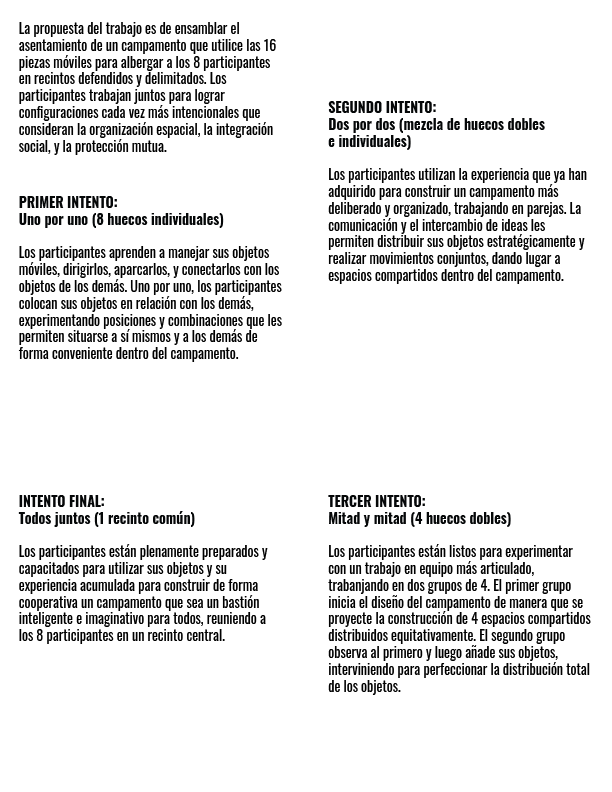
FIRST ATTEMPT: One by One (8 individual niches)
Participants learn to handle their mobile objects—guiding them, parking them, and connecting them with the objects of others. One by one, participants place their objects in relation to the others, experimenting with positions and combinations that allow them to situate themselves and one another in suitable ways within the camp.
SECOND ATTEMPT: Two by Two (a mix of double and individual niches)
Participants use the experience they have already gained to build a more deliberate and organized camp, working in pairs. Communication and the exchange of ideas allow them to distribute their objects strategically and carry out coordinated movements, giving rise to shared spaces within the camp.
THIRD ATTEMPT: Half and Half (4 double niches)
Participants are ready to experiment with a more articulated form of teamwork, working in two groups of four. The first group begins the design of the camp with the intention of constructing four shared spaces distributed evenly. The second group observes the first and then adds their objects, intervening to refine the overall arrangement.
FINAL ATTEMPT: All Together (1 common enclosure)
Participants are fully prepared to use their objects and the experience they have accumulated to cooperatively build a camp that functions as an intelligent and imaginative bastion for everyone, bringing the eight participants together within a central enclosure.